How to Know if Baby Is Not Getting Enough Breast Milk
Sometimes a breastfed infant may struggle to gain weight, either not gaining weight at all or not gaining enough weight to stay on their growth bend. This article looks at the possible reasons for non gaining weight and what to practice to get breastfeeding dorsum on track and baby well fed. This is a companion commodity to Understanding Your Baby's Weight Chart and Supplementing an Underweight Baby.
It is important to stay in shut contact with a health care professional if your baby is non gaining weight as expected as they will check for any underlying health concerns and be able to monitor your baby'due south weight regularly.
What are the reasons for a breastfed babe non gaining weight?
#one Not enough milk
In most cases the reason for not gaining enough weight is because the baby is non getting plenty chest milk. In that location could exist many potential reasons for this from issues of poor latch, breastfeeding on one breast per feed or on a schedule, to other causes of low milk supply such every bit insufficient glandular tissue, hormonal issues, delayed onset of lactation and more than. An International Lath Certified Lactation Consultant (IBCLC) is the ideal breastfeeding specialist to help y'all notice the Reasons for Low Milk Supply.
#2 Health issues for infant
Sometimes underlying wellness problems with the baby may be identified equally the cause of poor weight gain e.chiliad. breathing or cardiac bug, neurological issues, milk allergy, anaemia, genetic syndrome, low or high muscle tone, or undetected natural language tie (see below). Occasionally, lactose overload can be a cause of low weight gain.
#3 I thing leads to another
Once a infant is underweight they can go very sleepy and non very interested in feeding. Or they may seem hungry, but apace fall asleep at the breast instead of actively feeding. This type of infrequent feeding causes a mother's milk supply to drop which adds to the problem of low weight gain in a vicious bicycle.

Is my baby gaining enough weight?
If your babe is gainingsomeweight, you may wonder if you really do need to be worried or whether it is inside normal limits. It may assist to read Is My Baby Getting Enough Milk? and Agreement Your Babe's Weight Chart. The Earth Health Organisation (WHO) weight charts prove the expected growth curves seen in healthy breastfed babies. There are divide charts for boys and girls since they grow slightly differently. You can download these charts and plot your baby'due south weight yourself (weight for age 0-6 months GIRLS & BOYS) so yous tin see how your baby'south growth compares. At that place are also growth apps that can record baby'south weight on your phone that use the same charts.
Normal proceeds
The WHO charts prove that weight gains of 30g‑40g per day in the beginning three months are to be expected when a baby is growing well. This slows down between 3‑6 months to an average gain of 20g per day.
Crossing centiles?
If your baby is gaining less than effectually 30g‑40g per day in the first 3 months or less than about 20g per day betwixt iii‑6 months, their growth bend may start to drift away from their weight-for-age curve. It may brainstorm crossing the pre-drawn centile lines in a downwards direction. See Agreement Your Infant's Weight Chart for more information on centiles and examples of curves that prove faltering weight proceeds.
Crossing centile lines on the WHO chart may just be a sign that your infant'southward birth weight was inflated, peradventure you were on an Iv baste during labour. Or it may mean that your baby is destined to exist tiny and petite but like his parents, or long and lean like Uncle Larry. Or it may be because he has been poorly recently. Notwithstanding this can't be established past someone who has never seen you and your infant on Dr Google or in a Facebook thread. If your breastfed babe is consistently not gaining weight (or negligible weight) consider seeking the aid of an IBCLC lactation consultant to work with y'all and your wellness professionals; sooner rather than later. In that location is no advantage to waiting to see if the problem disappears.
Hungry or satisfied?
In improver to monitoring weight gain, it is useful to exist aware of some typical characteristics of both an underweight baby and i who is getting enough milk:
- The hungry/underweight infant.A baby who has not had enough milk may exist tense, with his arms bent at the elbow and held close to his body. He may fall asleep with his hands in tight fists and look worried with a frown on his face. A hungry infant may seem fussy and desire to stay at the breast for long periods which may be mistaken for breastfeeding "continuously" but actually he is not actively sucking or swallowing milk. Fussy behaviour or difficulty sleeping might also be attributed to colic, reflux, silent reflux or intolerance to mother's nutrition instead of hunger. Alternatively a hungry baby may sleep a lot and be mistaken for a "skillful baby". A very underweight baby can take loose skin and facial features that look like a little old man and he may have infrequent wet or dirty nappies. Signs of dehydration include dry lips and mouth, drowsiness, and dark, concentrated urine.1
- The babe who is total.When your baby has had enough milk or is full to satiety he will usually fall asleep and let get of the chest on his own afterwards a flow of active sucking and swallowing. He will take relaxed hands and probably a 'milk drunk' satisfied expression. He will have plenty of moisture and dirty nappies each twenty-four hours and good weight gain (encounter Is My Baby Getting Enough Milk? for more information).

Next steps
In an platonic scenario the health visitor or midwife will pick up on genuine poor gain at the first sign of a problem and refer the mother to a breastfeeding specialist to protect breastfeeding and ensure the babe gets more milk. A close eye volition exist kept on the baby's weight gain by weighing regularly (e.g. weekly or more than frequently). An IBCLC lactation consultant will ordinarily take a total medical history, study the baby'south weight nautical chart, sentry a breastfeed from get-go to cease and put a plan in identify to increase baby's intake of milk to become them back on rail.
Step one: feed the baby
If a baby is considerably underweight it may take fourth dimension to build his mother's milk supply and formula may exist needed at beginning unless donor milk is available or unless the baby is of an age when solid foods can make full the gap. Mothers who can't access donor milk and are reluctant to use formula may need gentle counselling to understand that the priority is to rebuild their baby's bodyweight and energy levels; they demand more than food. Information technology can help the mother to think of formula equally a necessary medicine to supplement direct breastfeeding.
If a mother can pump enough breast milk so that tin and should be used as the supplement instead. But we have to assume that for whatever reason, the baby is not able to get enough milk from the breast themselves and the first rule is to get the infant fed… to satiety (i.e. until they are full).
How to supplement the underweight infant
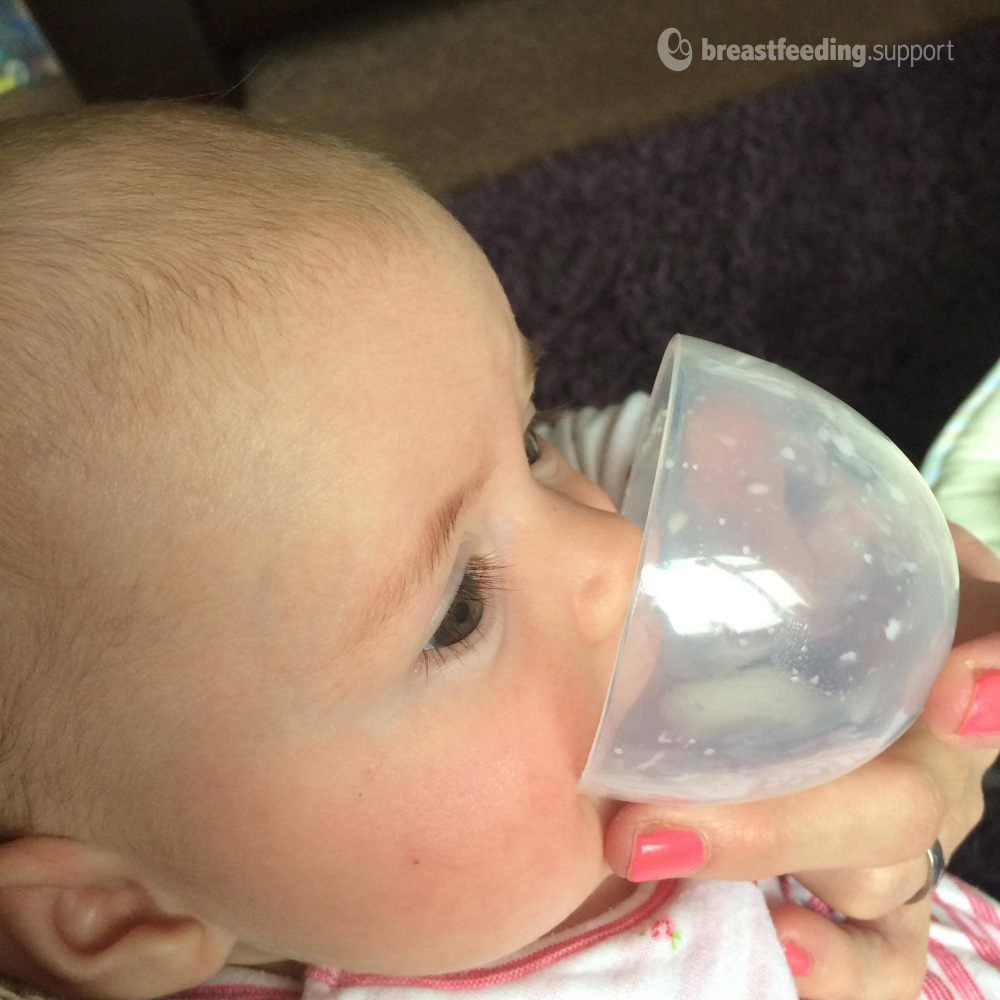
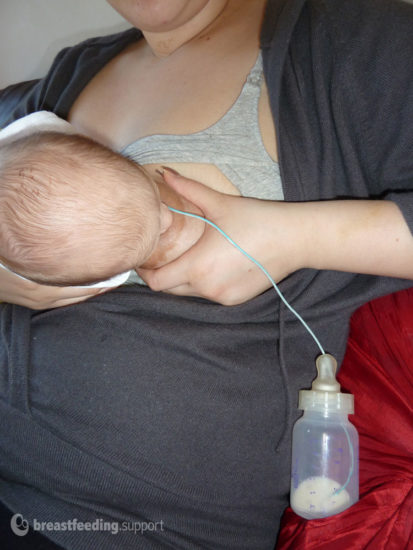
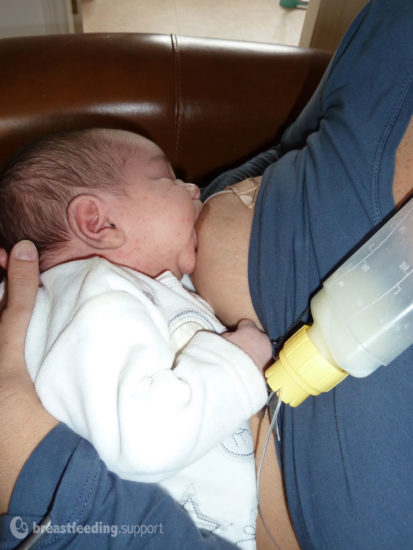
Tiptop-up supplements can be given to a babe by an open up loving cup, by supplementing at the breast (when a minor tube delivers supplement aslope the nipple (see pictures below) or by finger-feeding (baby suckles a finger with a feeding tube attached). A bottle can also exist used to requite supplements after each breastfeed and may be a good choice for the underweight baby who keeps falling asleep without feeding well. Although bottles can sometimes cause problems breastfeeding for some babies due to nipple preference or confusion, these Tips to Bottle Feed a Breastfed Baby can assist. Topping up by canteen before a breastfeed is another option. Run into our intendance program: Supplementing an Underweight Baby for much more information. With more than milk inside him, your infant will take more energy to breastfeed effectively.
Stride two: build mother's milk supply
With infant'due south calorific needs met in the short-term, work can brainstorm on maximising a mother's milk supply. Subsequently breastfeeding from both breasts for a combined total of around 20-30 minutes, time spent pumping or mitt expressing will stimulate the breasts more finer than continuing to breastfeed for hours at a time with a baby who isn't really drinking (and isn't gaining weight). Meet How to Brand More Breast Milk and How to Increase Milk Supply When Pumping for ideas to maximise your supply.
Take hold of upwardly growth
If your baby has been short on calories for some time, there will normally be proficient grab upward growth once they are getting more milk. Gains of at to the lowest degree 56g per twenty-four hours2 can be expected for several days or longer. Weight gains up to 120g per 24-hour interval could be possible 3. Your babe may becomevery interested in feeding and may take more and more supplement when their appetite returns and they start to take hold of up.
All children with failure to thrive need additional calories for grab-up growth (typically 150 percent of the caloric requirement for their expected, not actual, weight).
Unless the infant has an underlying medical problem, failure to begin catch-up weight gain ways insufficient supplement is existence given.
Watch out for poor advice
Hopefully your health professional will exist very knowledgable most breastfeeding. Unfortunately they may not exist or you may come across poor advice from elsewhere. Communication to keep to 1 breast "to achieve the hind milk" will more often than notreduce your milk supply (read more here and here). Communication to feed more oftentimes or for a certain number of minutes isn't helpful if that baby isn't very expert at feeding, why spend more time doing something that already doesn't work? Alternatively the advice you hear may be to supplement with formula—without addressing the underlying breastfeeding problems. Keeping to one chest or suggesting formula instead of breastfeeding without actively trying to increase a female parent's milk can undermine breastfeeding and cause early weaning.
Seek a second opinion
At the other farthermost, a health professional person or the mother herself may exist so pro-breastfeeding that she is overly optimistic nearly the low weight gain picking upwardly soon all on its own. They may continue to monitor the situation without taking activity when weight gain is as low as 12g per day or even less. They may think that if baby is following his own curve he is OK, even if it is well beneath the nautical chart. If this is the case for you, asking for a second stance from a paediatrician volition ensure that your infant is fit and healthy and there are no wellness concerns. Afterward all a few salubrious babies will be on the 1st centile. If not, an IBCLC can help y'all brand a tailor made plan to increase your milk supply and get your baby taking more calories.
NICE guidelines
Prissy (National Institute for Health and Care Excellence) guidelines recommend further medical assessment for unpleasing growth if a baby's weight falls across two or more centile spaces if birthweight was between the 9th and 91st centiles and a fall beyond one or more than centile spaces if they were born below the 9th centile.four
Avoid Dr Google and Nurse Facebook
When a mother desperately wants to breastfeed, and is worried about her infant, she may look to search engines on the internet and social media platforms. She may notice breastfeeding forums where mothers reassure her that their babies didn't gain much weight either but they were fine, and that she is doing corking, and that breastfeeding is the best thing for her babe. They may tell her "carry on hun" or another favourite "it sounds but like a natural language-necktie". However these cheer leaders often don't ask whatsoever important questions; they can't run into the baby's weight chart; they are not trained breastfeeding specialists. Following this kind of communication may lull the mother into a fake sense of security while her baby continues to neglect to thrive and her milk supply gets less and less.
A note on tongue-tie
Although it may be the latest trend on Facebook, not everything that goes incorrect in the breastfeeding world is about tongue-tie. Many low weight gain babies will show poor tongue activity because they are very tense and very hungry. Yes, there may exist a tight frenulum (the membrane nether the tongue), but let your IBCLC or experienced tongue tie practitioner advise y'all, not Dr Google. Dividing a tongue tie and and so expecting everything to turn out cracking as if past magic is lulling you lot into a imitation expectation. If a baby is 25-thirty% below their expected weight for age, your milk supply is likely already compromised and waiting around for the magic on the tenuous footing "it tin have 2‑3 weeks to work out how to use their tongue" can mean 2‑3 more than weeks of slipping backside in calories.
Prevention is amend than cure
Unfortunately IBCLCs practise come across babies 30% below their expected weight in the community. At this point there may already be a referral to a paediatrician. Social services may even accept been called. And everyone volition be worried. By getting the correct assistance as soon equally in that location are early concerns, this upsetting situation tin can hopefully be avoided.
The consequences of inadequate intake of breast milk range from hyperbilirubinemia, infant hunger, and slow weight gain to life threatening, and fifty-fifty fatal, dehydration and starvation.
Summary
A infant who is very nether weight may not be able to breastfeed finer and his mother's milk supply may exist very low. An action plan involves increasing a baby'southward calorie intake with supplements, edifice his mother's milk supply and finding the underlying reason for depression weight gain. There are lots of ideas on this website for increasing your milk supply to get yous started, but for specialist help consult an IBCLC lactation consultant alongside your doctors. Choose one who can spend the fourth dimension needed to have a total history, make an private care plan and liaise with your health care professionals.
Source: https://breastfeeding.support/baby-not-gaining-weight/
Belum ada Komentar untuk "How to Know if Baby Is Not Getting Enough Breast Milk"
Posting Komentar